
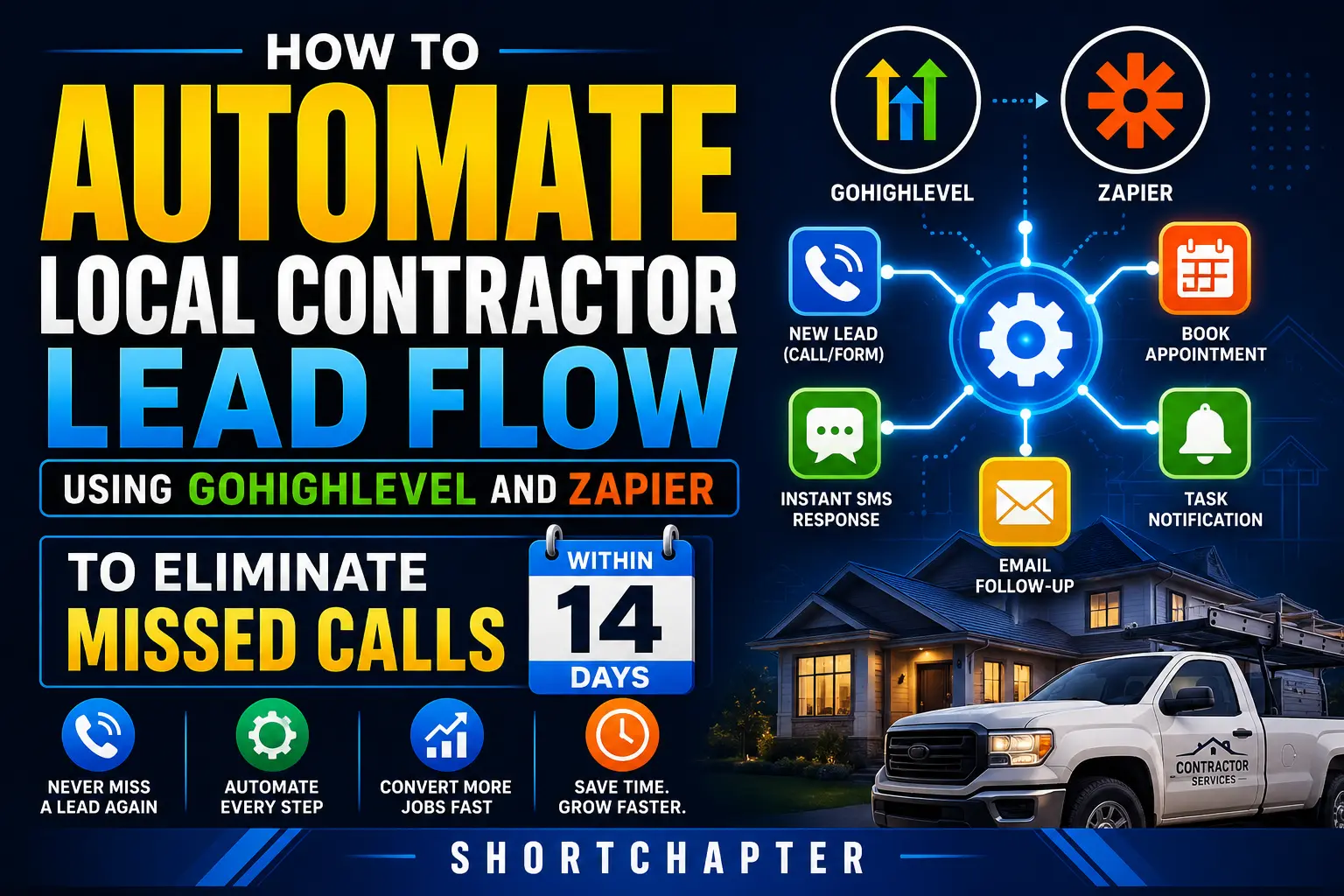
How to Automate Local Contractor Lead Flow Using GoHighLevel and Zapier to Eliminate Missed Calls within 14 Days
The Business Blueprint That's Helping Trade Owners Stop Losing Customers to Voicemail
It was a Tuesday afternoon, and Mike was under a kitchen sink elbow-deep in a busted P-trap.
His phone buzzed in his back pocket. He couldn't answer it. He never can, not when he's mid-job.
By the time he wiped his hands and called back three hours later, the homeowner had already booked someone else.
That's not a story about a bad plumber. Mike is great at his job. That's a story about a business losing money for reasons that have nothing to do with the actual work.
If you run a trade business plumbing, HVAC, electrical, landscaping, a salon, an auto shop you've probably lived some version of this. You're excellent at the craft. The phone, the follow-up, the scheduling? That's where things fall apart.
Why This Keeps Happening (And Why It's Not Your Fault)
Here's the real problem nobody tells you upfront: your business runs on two completely different skill sets.
One is the trade itself. Fixing pipes, wiring panels, cutting hair, tuning engines. You spent years getting good at that.
The other is customer acquisition answering calls, following up on quotes, staying top of mind so people call you again next time. Almost nobody trains for that part. You just get thrown into it.
Most advice for this problem tells you to "hire a receptionist" or "get better at marketing." That's expensive, slow, and honestly, most small trade businesses can't justify a full-time hire just to answer phones during job hours.
So the calls keep going to voicemail. The follow-up texts don't get sent. The five-star reviews never get asked for. Not because you don't care, but because you're one person (or a small crew) already stretched thin doing the actual work customers are paying you for.
The Quick Win: Fix the Leak Before You Fix Anything Else
Before we get into the bigger blueprint, here's one thing you can do today.
Set up a simple auto-text that fires the moment you miss a call. Something like: "Hey, sorry I missed you I'm on a job. Text me what you need and I'll get back to you within the hour."
Most phone carriers and basic call-answering tools can do this in under ten minutes. It costs almost nothing.
This one habit alone recovers a huge chunk of the customers who'd otherwise hang up and call your competitor. It's not fancy. It's not "AI-powered" in any deep sense. But it plugs the biggest leak first.
Now let's build the real system around it.
The Framework: Four Places AI Actually Helps a Trade Business
Forget the hype for a second. AI isn't going to run your business for you. What it can do is handle the repetitive, time-sensitive stuff that used to require a person sitting by the phone all day. Here's where it actually pays off.
1. Never Miss a Lead Again
The idea: Most trade businesses lose customers not because of bad work, but because of slow response times. Homeowners calling about a leaking pipe or a dead AC unit are usually calling three or four people at once. Whoever responds first often wins the job.
Real example: A small HVAC company in Texas started using an AI answering tool that picks up calls after hours, asks basic questions (what's wrong, address, best time to call back), and texts the owner a summary. Within two months, they'd recovered roughly 15 jobs a month that used to go straight to voicemail.
How to apply it: Look for a call-answering or chatbot tool that can capture the basics name, issue, urgency, contact info and immediately notify you. You're not replacing yourself. You're buying back the hours you used to lose.
2. Follow Up Automatically, Without Feeling Like a Robot
The idea: You gave someone a quote. They said "let me think about it." Then life happened, and neither of you followed up.
That gap is where a huge amount of trade business revenue quietly disappears.
Real example: A landscaping company started sending a simple automated text three days after every quote: "Hey, just checking if you had any questions about the estimate happy to walk through it." Nothing salesy. Just a nudge. Their close rate on quotes went up by almost a third.
How to apply it: Set up a basic sequence one follow-up at 3 days, one at 10 days, then stop. Keep the language exactly how you'd actually talk to someone. If it sounds like a corporate email, people tune it out.
3. Turn Happy Customers Into Your Best Marketing
The idea: Reviews are the modern version of a neighbor recommending you over the fence. Most trade businesses know this. Almost none of them ask consistently, because it's awkward to remember in the moment.
Real example: An electrician started using an automated text that goes out the evening after a completed job: "Thanks for having us out today! If you've got a minute, a review would really help us out." It's not manipulative. It's just consistent, which most businesses aren't.
How to apply it: Automate the ask so it happens every single time, not just when you remember. Consistency beats cleverness here.
4. Keep Your Schedule From Turning Into Chaos
The idea: Double-bookings, forgotten appointments, and last-minute cancellations cost trade businesses real money every week.
Real example: A salon owner started using AI-driven scheduling that sends automatic reminders 24 hours and 2 hours before appointments. No-shows dropped noticeably within the first month, because people simply forgot less.
How to apply it: Any basic scheduling tool with automated reminders solves most of this. You don't need anything complicated. You need something consistent.
What I've Actually Seen Work (and What Doesn't)
Here's the honest part. Not every trade business that adopts these tools sees results right away.
The ones that struggle usually try to automate everything at once calls, follow-ups, reviews, scheduling, ads in the same week. It gets overwhelming, and half of it never gets set up properly.
The ones that succeed pick one leak, fix it, let it run for a few weeks, then move to the next one. Slow and steady beats "install everything Saturday afternoon."
One roofing contractor I came across started with just the missed-call text-back. That was it, for the first month. Once that was working smoothly, he added automated follow-ups. Two months after that, reviews. By month four, his lead-to-booked-job rate had improved enough that he raised his prices slightly and still stayed booked out three weeks in advance.
That's the pattern worth copying. Not speed. Sequence.
Frequently Asked Questions
Do I need to know how to code to set any of this up? No. Nearly every tool mentioned here is built for non-technical business owners. Most are drag-and-drop or fill-in-the-blank setups.
Will this replace the personal touch my customers love? It shouldn't, if it's set up right. The goal is to automate the boring, repetitive parts not the actual relationship. Customers still talk to you. They just don't fall through the cracks while you're on a job.
How much does something like this usually cost? Basic call-answering and text-follow-up tools often start around $30 to $100 a month. Scheduling tools are similar. It's usually far cheaper than the cost of the leads you're currently losing.
What if I only have a few hours a week to set this up? Start with the missed-call text-back. It takes under ten minutes and solves the single biggest leak most trade businesses have.
Is this only useful for bigger companies? No actually the opposite. Solo operators and small crews benefit the most, since they don't have a receptionist or office staff to catch what falls through.
Can I set this up myself, or do I need to hire someone? Most tools are built for self-setup. If you get stuck, most providers offer support to walk you through it.
Will customers know they're talking to an automated system? For text follow-ups and reminders, usually not they read like a normal message from your business. For call answering, some tools are voice-based and some route to a real person; you can choose based on what feels right for your customers.
What's the very first step if I want to try this? Pick the one leak that's costing you the most jobs right now missed calls, forgotten quotes, or no-shows and fix that one thing first.


.png&w=3840&q=75)