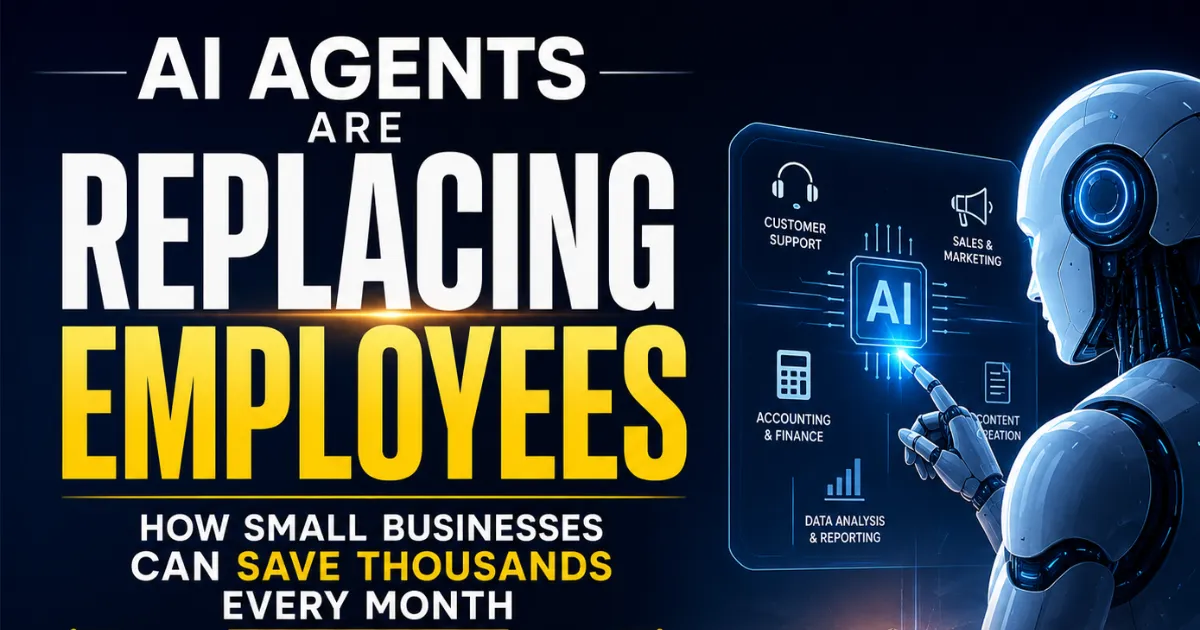
AI Agents Are Replacing Employees What's the Reason, Replacing Expensive Tasks with AI Agents
The 11 PM Payroll Panic
Picture this scenario. It is 11 PM on a Tuesday.
You are staring at a spreadsheet filled with payroll numbers, contractor invoices, and software subscriptions. Your business is growing, but your bank account is not.
Every time you get a surge of new customers, you have to hire more help just to handle the workload. You thought this was how growth worked. Instead, it feels like a trap.
You are working longer hours just to pay other people to help you work. You need a better way to operate. You do not need more software to manage.
You need something that actually does the work for you. That is where AI agents enter the picture.
Why the Old Way of Scaling is Broken
Most business owners think the only way to scale is to hire more people.
But hiring is exhausting. You spend weeks interviewing, months training, and thousands of dollars, only for someone to quit a year later. Then the whole painful process starts over again.
Traditional automation tools do not fix this problem. They just move data from one place to another. You still have to be the brain making all the decisions.
That is exactly why you feel stuck.
You spend your entire day managing people and fixing small mistakes instead of growing your business. The common advice is to simply delegate. But delegating to humans is expensive and messy.
Your Quick Win: Get 10 Hours Back This Week
Let’s secure a quick win right now before getting into the heavy stuff.
Do not try to rebuild the whole company today. Pick the one inbox that causes the most stress. For most businesses, this is customer support.
Go to a simple AI tool like Chatbase or CustomGPT. Upload the company website link, the return policy, and the top 10 most common questions.
In about 15 minutes, an AI agent is ready to instantly answer 80% of routine customer emails. You just saved hours of typing the exact same responses.
The 2026 Business Blueprint: Agents Over Employees
If you are looking for new business ideas or ways to restructure a current company, understanding this shift is crucial.
AI has moved past just writing blog posts or summarizing emails. These are not basic chatbots anymore. These are AI agents.
An agent does not just talk. It acts.
It can read an email, decide what needs to be done, log into software, make a change, and reply to the customer. Let's look at three areas where this business blueprint replaces expensive roles.
1. The 24/7 Customer Support Rep
A human support rep needs sleep, weekends off, and a salary.
An AI agent works 24/7, speaks 50 languages, and never has a bad day.
The Example: A small e-commerce store pays a part-time contractor $1,500 a month to handle basic customer questions. The contractor only works from 9 to 5. If a customer has a problem on Friday night, they wait until Monday.
How to apply it: Connect an AI agent to a customer service platform like Zendesk. Feed it all past support tickets. The agent reads incoming emails, checks order statuses in Shopify, and issues refunds based on exact rules. Business owners only step in for complex, angry emails.
2. The Relentless Sales Development Rep (SDR)
Finding leads and sending cold emails takes hours of manual research. Paying a human to do this is incredibly expensive because most emails are ignored.
The Example: A local marketing agency spends 15 hours a week searching LinkedIn for local plumbers and guessing their email addresses.
How to apply it: Build an AI workflow using a tool like Clay and an AI agent. The agent scrapes Google Maps for plumbers with bad reviews. It finds the owner's email and writes a highly specific, personal email offering to fix those reviews. The agent does the work of a $60,000-a-year SDR for about $100 a month.
3. The Perfect Operations Assistant
Small businesses often drown in admin work. Moving data from an invoice into a spreadsheet, organizing files, and scheduling meetings drains energy.
The Example: Think about the time spent matching receipts to bank statements at the end of every month.
How to apply it: Set up an agent in Zapier that automatically watches an email inbox for receipts. When one arrives, the agent reads the PDF, extracts the amount and vendor, logs it into QuickBooks, and files the receipt in a Google Drive folder. No human ever has to touch it.
The Hard Truth About Replacing Jobs
Talking about replacing employees with AI makes some people uncomfortable.
But the reality of running a small business is keeping the doors open. Paying human beings to copy and paste data is no longer sustainable in 2026.
Using AI agents does not mean firing everyone. It means stopping the hiring of humans for robotic tasks. The AI handles the boring tasks.
This allows businesses to afford paying good money to humans for creative, strategic work. Industry observations show that companies adopting this model operate with significantly lower overhead costs while maintaining the same output.
Frequently Asked Questions
Do you need to know how to code to build an AI agent? No. Most AI agent platforms in 2026 are completely visual. If you can drag and drop boxes on a screen, you can build an agent.
How much do AI agents actually cost? It varies widely. You can build incredibly powerful agents for between $50 and $200 a month. Compare that to a $4,000-a-month employee.
Will customers hate talking to an AI? Customers hate useless bots that trap them in a menu. If an AI agent actually solves their problem instantly—like processing a return or finding a tracking number—they will love it.
Is business data safe with these AI tools? Caution is necessary. Always choose enterprise-grade tools that specifically state they do not train their public models on private data.
Can AI agents really replace a full-time person? Rarely a full person all at once. Usually, an AI agent replaces a specific role or a block of tasks. This frees up the existing team to do more, preventing the need to hire that next full-time person.
Ready to Build Your Team of Agents?
Transitioning to an AI-driven team feels overwhelming at first. You might be wondering exactly which tool to buy or which process to automate first.
If you would like help implementing this, you do not have to figure it out alone. Having a clear, step-by-step business blueprint makes all the difference.
Mapping out daily tasks and handing them over to AI, one by one, is the next logical step to reclaiming your time.
The Bottom Line on AI for Small Business
The businesses that thrive in the next few years will not be the ones with the biggest teams.
They will be the ones with the smartest systems. Bringing AI agents into daily operations stops the cycle of trading limited time for basic tasks. You finally get to step back and act like a business owner, not an overworked employee.
Your action step for today is simple. Pick one repetitive task that annoyed you this week, and find an AI tool to do it for you tomorrow.